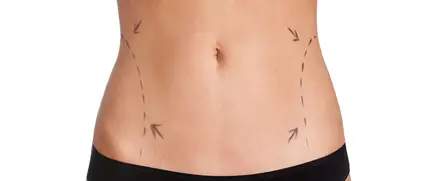
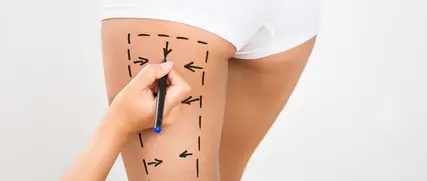
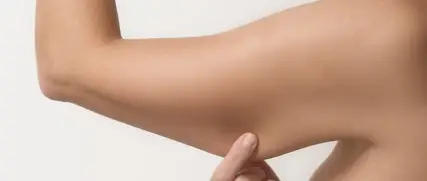
Apart from the particular case of breast augmentation implants and liposuction, procedures on the breasts, abdomen, buttocks and thighs share common characteristics:
- general anaesthesia,
- a hospital stay of 1 to 3 days on average,
- visible scars.
Anaesthesia
These procedures involve removing excess skin, or skin and fat, or skin and mammary gland in the case of a breast reduction. They are therefore superficial procedures, not comparable to operations that open the abdominal cavity, for example. However, as I have warned you, these are operations that should not be taken too lightly, because they are more tiring than one imagines, and a period of rest with limited activity for 15 days is necessary after the procedure. You will of course be put completely to sleep, after an assessment of your state of health.
Recovery and scars
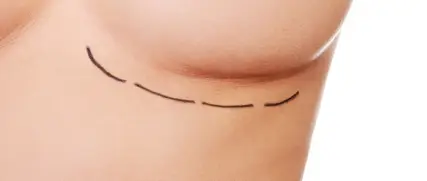
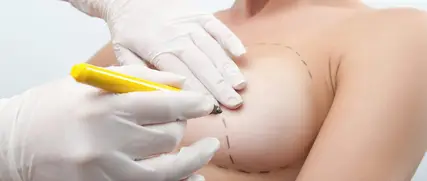
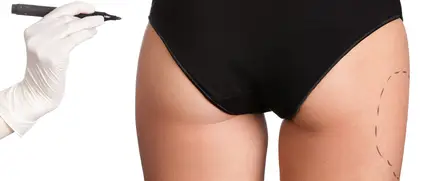
The incisions, and therefore the final scars, will be placed as well as possible so that they can be hidden by clothing or a swimsuit.
I will show you where these scars will be. How long the scars remain visible is a delicate question that must be clearly understood before deciding on the operation, because this is where the real risk of cosmetic surgery on the body lies: one can never be sure in advance of the quality of the scar, since it depends largely on you, on the nature of your skin and on how you will react.
I promise to bring together the most favourable conditions, that is, careful suturing with a running intradermal stitch, which leaves no marks. If there is some tension, I will have you wear adhesive strips on the skin to relieve the scar. And yet the scar, which will look very fine at first, will evolve differently from one patient to another.
You may be lucky enough for the scar to remain very fine, to barely redden, and then to fade within a few months until it is hardly visible.
Unfortunately, it may also redden strongly, even become raised, and then flatten and fade very slowly, over 6 to 18 months.
Most cases are in between: the scar is fairly visible, slightly red around the 2nd or 3rd month, and fades from the 6th month.
In any case, it is rare that one can ultimately speak of an invisible scar. It may be barely visible, and on the breasts hardly more than the equivalent of a bra mark, but it may also remain visible, even if it continues to fade with time.
Perhaps one day this phenomenon will be mastered and a scar as fine as a wrinkle guaranteed every time. The situation has nevertheless improved considerably thanks to advances in surgical technique and suture materials, but we still do not know why, sometimes, say one time in ten, the scar will defy my care and demand a good deal of patience from you.
In conclusion, I would remind you that a procedure on the body is only justified if it is worth it, if your current situation bothers you enough that you are prepared to accept an imperfect scar if need be.
However, the technique of suctioning excess fat can solve certain figure problems without leaving scars. A suction cannula connected to a very powerful aspirator is introduced through a 1 cm incision, and the excess fat can thus be removed. This technique is often useful in combination with surgery. It can be used on its own, in particular to solve the problem of “saddlebags” in young women.
Thromboembolic risks
Most body procedures carry a risk of phlebitis. To keep this possibility to a strict minimum, several measures must be taken:
- wearing compression stockings or socks during and after the operation for a few days;
- getting up early, from the next day, to promote circulation in the limbs;
- a prescription for anticoagulant medication, most often necessary for several post-operative days. The duration and dosage of this additional prescription are of course adapted case by case.
By applying these various measures, even if one can never say that the risk becomes nil, it can at least be reduced to a minimum.