
Home / Cosmetic surgery of the face / Wrinkle filling: laser, Botox, dermabrasion
Variable
Outpatient: at the practice
Variable
Facial ageing shows itself in three ways:
The cervico-facial facelift and the brow lift can only act effectively on two of the components of facial ageing: the loosening of the skin and deep layers, which can be corrected by retightening, and the excess fat, which is removed by suction and excision.
They do not, however, act on wrinkles. The facelift can nevertheless be used as an opportunity to act on the muscles responsible for certain wrinkles: crow’s feet and above all the vertical and horizontal wrinkles of the forehead can be effectively reduced by weakening the muscles responsible while keeping normal mobility.
Wrinkles on the cheeks are temporarily reduced by retightening the skin, but will gradually reappear. Likewise, the effect is very slight on the nasolabial fold (the crease between the nose and the cheek) and nil on existing wrinkles around the lips.
Surgically, the muscles responsible can be weakened. This is the best approach for wrinkles at the temples and forehead. The skin can be retightened, but the effect is limited. Wrinkled skin can also be smoothed by treating it from the outside with a chemical product (a peel) or with an abrasive wheel (dermabrasion or resurfacing).
One can also try to mask the wrinkle by injecting a substance under the skin to raise its base. Hyaluronic acid has gradually replaced collagen, both giving satisfactory but temporary results. Tolerance is normally excellent. Body fat, taken from an area of excess such as the abdomen or buttock, can also be injected under the wrinkle.
Partial resorption is inevitable, but the injections can be repeated.
Passing an electric current, electro-ridopuncture, is also used.
All these methods have their value in reducing wrinkles, but above all I would like you to understand that there is no competition between them and the “facelift”, because the objective is not the same. The facelift can do nothing, or almost nothing, for wrinkles, whereas these wrinkle-reduction methods can do nothing to remove excess skin and sagging. Crow’s feet and forehead wrinkles can be reduced during a facelift, but Botox is very effective in these two specific areas.
Dermabrasion, or resurfacing, consists of sanding the skin with a small abrasive disc driven by a small motor.
This creates a kind of superficial graze. A crust forms and falls off within a few days, revealing healed skin that will be smoother. It takes four to six weeks for the pink colour to fade and the appearance to return to normal. During this time, you can wear make-up but must not expose yourself to the sun. This resurfacing is used to reduce acne scars and wrinkles on the upper lip. It can be repeated at six-month intervals if necessary.
The “chemical peel” involves applying caustic products to the skin, either mild acids or phenol-based products (stronger), which causes a kind of superficial burn. Here too, a crust forms and healing takes place underneath. Sun exposure must be avoided for quite a long time, and great care must be taken with this method, which can give good results in the case of deep and numerous wrinkles, but carries the risk of a permanent change in pigmentation.
The “superficial laser” has become the method of choice for many practitioners for the external treatment of wrinkles. It is a defocused laser, allowing very controlled removal of a superficial layer of the skin. This precision makes it possible to treat areas of very thin and very fragile skin, such as the eyelids.
The procedure is performed under light anaesthesia (sedation or neuroleptanalgesia), after which either a dressing or a cream is applied for about ten days. Healing is then achieved, but the treated area is pink, and it takes a variable period of 10 to 60 days to recover normal colouring. Make-up, which will also protect from the sun, is used during this period.
The great advantage of the superficial laser is that the skin regains a normal appearance and texture in the absence of complications. These (prolonged redness, depigmentation, scars) can occur as with all superficial methods, but everything usually settles with time and appropriate treatment.
Laser treatment can be performed on the whole face, which has the advantage of an even temporary colouring that is easier to cover with make-up. It also avoids contrasts between treated and untreated areas, and is particularly effective for wrinkles on the cheeks and forehead. This full-face treatment can be carried out after a facelift, or sometimes instead of one when wrinkles predominate over sagging.
I often recommend dermabrasion, although it is not always fully effective. Some results are excellent and long-lasting, others are insufficient. The great advantage of dermabrasion is that the risk of after-effects is extremely low. I have personally not observed any among my patients. The lip regains a perfectly normal appearance, suppleness and colour, provided that the post-operative precautions have been observed, in particular no sun exposure for at least two months. It is therefore a procedure to be performed in winter.
Lip wrinkles are not always satisfactorily improved by the superficial laser. As with dermabrasion, 50% of cases respond well, 50% are merely reduced. There are, however, usually no marks, and the treatment can be repeated.
The phenol peel is more consistently effective, the wrinkles disappear, but this method carries a risk of permanent depigmentation which I find worrying, and I prefer to keep the peel as a last resort if dermabrasion or laser have been insufficient. In any case, I do not perform peels myself, and will refer you, if necessary, to a dermatologist competent in this field.
Mechanical dermabrasion and peels are prohibited. With the laser, on the other hand, the results are usually excellent (see the Eyelids page).
New lasers are constantly being introduced, giving better results with simpler recovery. The fact remains that sufficient superficial destruction is necessary for a good result, and the skin still has to heal.
See the SOFCPRE information sheet on dermabrasion (in French) >>
See the SOFCPRE information sheet on facial peels (in French) >>
See the SOFCPRE information sheet on facial laser resurfacing (in French) >>
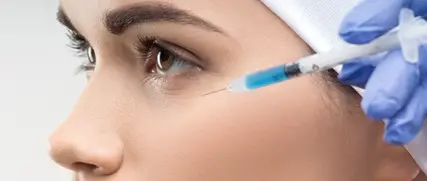
This is botulinum toxin, which has a paralysing action on the muscles. Injections produce an effect that lasts several months. The action is useful on the muscles of the forehead and on crow’s feet.
The drawback is the possibility of diffusion to the upper eyelids, causing temporary drooping (see the specific information sheet). The effect takes several days to develop, sometimes up to two weeks. Once the effect has worn off, after 3 to 9 months depending on the individual, the treatment can be repeated.
See the SOFCPRE information sheet on Botox (in French) >>
See the SOFCPRE information sheet on botulinum toxin injections (in French) >>
Many so-called “filler” products have appeared on the market over the past several years. They are mainly presented as substitutes for surgery. For my part, I believe they are not in competition with surgery: they often precede it, and may possibly complement it.
Nevertheless, permanent products, whose very long-term effects cannot be known, are now prescribed in France and in many European countries. The example of late inflammatory reactions after direct injections of silicone oil 20 years ago is not so rare, and can pose almost insoluble problems of correction. I invite you to discuss this with your dermatologist, who most often has experience in this field. Hyaluronic acid derivatives are, in the vast majority of cases, very well tolerated, and are resorbed in about 6 months. Small residual nodules at certain injection sites are exceptional.
See the SOFCPRE information sheet on injections (in French) >>
See the SOFCPRE information sheet on hyaluronic acid (in French) >>
See the SOFCPRE information sheet on filler injections (in French) >>
34 Avenue d'Eylau 75016 Paris
Personal assistant Else STOKER
TELEPHONE +33 (0)1 53 57 87 65
WHATSAPP +33 (0)6 83 55 29 04
Monday to Friday

Cosmetic, plastic and reconstructive surgery
© All Rights Reserved.