1 hour 30
1 day
3 to 6 months
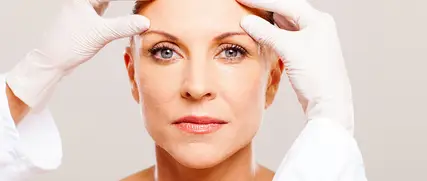
When you have concerns about the state of your forehead, an examination is needed to assess the respective contribution of:
If a facelift has been considered, combining it with a brow lift often allows the temple area to be smoothed more effectively, and gives better harmony to the various parts of the face.
With the widespread use of Botox, requests for brow lifts are increasingly rare, even exceptional.
This correction of the forehead can be performed through a long incision in the hair, which is rarely done for this purpose today. Thanks to endoscopy, the same result can be obtained using only small, short incisions. Through these incisions, an endoscope with optical fibres is introduced, which provides a magnified image on a screen, along with special fine instruments. All the steps that were previously performed after making the long incision in the hair can then be carried out under excellent visual control.
It is essentially a matter of weakening the muscles located between the eyebrows which, by contracting, are responsible for the formation of the vertical wrinkles and the horizontal wrinkles at the base of the nose. Weakening means removing about three quarters of the muscle, which means that movement will still be possible, but with reduced force.
The other important element is a transverse spreading that “smooths out” the central part of the forehead, between the eyebrows and at the root of the nose. This manoeuvre will also reduce the horizontal wrinkles of the forehead by lessening the force of the muscle that raises the eyebrows, the frontalis muscle.
With the classic brow lift operation, a strip of scalp was removed to retighten the forehead. With endoscopy, there is no longer any resection, and I secure the tissues in the correct position with fibrin glue, already used for the face and neck. This gluing makes it possible to fine-tune the ideal repositioning for each patient: transverse spreading, smoothing of the root of the nose, more or less elevation of the eyebrows, elevation of the temple area.
When the forehead is very high, it may nevertheless be useful to make an incision in front of the hairline, which in fact even makes it possible to bring the hairline forward while the forehead is corrected endoscopically. Very carefully performed, the suture leaves very few traces.
Finally, this endoscopic procedure on the forehead can be extended to the face, by continuing the release towards the cheekbones. Combined with a procedure on the lower eyelid, this will lift the cheekbones and the cheeks.
The ease of use of Botox, particularly for the wrinkles between the eyebrows (glabellar lines), reduces the need for a brow lift, notably as a preventive measure. The indications for a brow lift are becoming less and less frequent.
The cast is removed after six to ten days.
Do not rush to the mirror, unless you are one of those patients who show very few marks. Quite often there is some swelling at the root and on the sides of the nose, and bruising of the lower eyelids is common.
All of this settles quickly, and three weeks after the operation there is usually nothing left to see. Even right after the cast is removed, lightly tinted glasses will let you go completely unnoticed, as the nose itself looks almost normal straight away. These glasses must not rest on the bridge of the nose: you will need glasses with side supports, or glasses suspended from the forehead with tape. In any case, you will come back to see me during the first month, so that I can monitor your progress and advise you on local care.
Usually, no trace of the operation should be visible after three weeks. The tip of the nose will remain slightly sensitive and a little stiff, and it will in fact take six months to a year for everything to return to normal; throughout this time the nose will continue to refine, to lose its swelling and to regain its suppleness. You will then come back to see me so that we can assess the final result together.
I advise you to avoid the sun during the first few months, as your nose would swell much more. You can protect yourself with a hat, sunscreen, or even a small paper nose guard.
After two to three months, your nose will be as strong as before, no more and no less. If you receive a blow, a fracture may occur, which will have to be treated like any other nasal fracture, by repositioning the displaced bones.
You will be able to resume all your normal activities after three weeks, including all sports, except scuba diving, which should be avoided for six weeks. Your sense of smell should not be permanently affected by the operation, but it may be reduced initially because of the swelling of the mucous membranes.
Some irregularities may appear as healing progresses, some temporary, others more permanent. As I have explained, a touch-up is sometimes necessary, but in general it is best to wait one year before performing it, in order to obtain the best final result.
When the nose was initially very asymmetrical, a slight residual asymmetry may persist, but as I have explained, the two sides of the face are never perfectly symmetrical in their natural state, and a minimal degree of asymmetry is entirely acceptable.
34 Avenue d'Eylau 75016 Paris
Personal assistant Else STOKER
TELEPHONE +33 (0)1 53 57 87 65
WHATSAPP +33 (0)6 83 55 29 04
Monday to Friday

Cosmetic, plastic and reconstructive surgery
© All Rights Reserved.