Facial lipofilling: lips, dark circles, wrinkles
Home / Cosmetic surgery of the face / Facial lipofilling: lips, dark circles, wrinkles
Facial lipofilling: wrinkle filling, facial rejuvenation
Duration of the procedure
30 min to 2 hours
Hospital stay
Outpatient
Final result
3 to 6 months
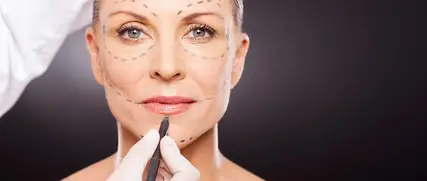
It is possible to harvest your own fat (from the abdomen, for example), in moderate quantities, and re-inject it into the hollows of the face.
This is a true graft which, in addition to the filling capacity of any injectable, transfers the stem cells present in your own fat.
This fat transfer has a plumping effect and improves the texture of the skin. Of course, it must be done without excess in order to keep a natural appearance.
See the SOFCPRE information sheet on this procedure (in French) >>
Re-injecting one’s own fat is what defines lipofilling, also called liposculpture, which has developed considerably since the late 1990s.
Yet surgeons had always attempted this manoeuvre, with failure rates so high (almost complete resorption of the injected fatty tissue) that the technique itself had been discredited. The reason was a lack of biological understanding of the fragility of fat cells, almost all of which do not survive the suction and re-injection process, unless the protocol developed by Coleman (USA) is followed: very gentle liposuction, low-speed centrifugation, and re-injection with fine cannulas into multiple subcutaneous micro-tunnels.
Thanks to this protocol, a survival rate of the injected tissue close to 70% can be achieved. Despite these strict rules, the survival of this true fat graft remains unpredictable and depends on many factors: age, smoking, blood supply of the recipient site, history of radiotherapy, and the quantity of fat re-injected, as too large a quantity is detrimental to its own survival in the recipient site.
These various parameters make the face an exceptional recipient site because, in addition to the fact that facial ageing is accompanied by a loss of fat in the upper cheeks and cheekbones, the blood supply is excellent and the quantities injected need only be minimal.
It is on this last point that the use of the technique differs from what was initially proposed in the United States, where some suggested rejuvenation by injecting fat alone into the face (far too much!), with results so excessive that they are unacceptable in European practice, where the rule is discretion of the final result.
It is therefore most often in combination with a facelift that this procedure will be offered. The harvest (minimal liposuction) is taken from the inner knees or the lower abdomen, only a few millilitres being needed for re-injection, most often into the cheekbones or cheeks, which restores a very natural appearance through a moderate increase in volume while reducing the need for traction during the facelift.
Nevertheless, this fat re-injection can be performed in combination with eyelid surgery alone, if the state of the face does not yet call for a facelift, or on its own, in a patient who has only an isolated loss of fat in the cheekbones. In the latter case, bruising is practically absent, and there is only an initial swelling, more or less pronounced, which may last a week. This may be combined with a slight initial over-correction, since a loss of at least one third must be anticipated. The final result is visible 3 to 6 months after the procedure, resorption being the main problem in the long term.
Recent advances in biological knowledge of fat transfer help to explain, to some extent, why injecting fat under an old scar improves its appearance, since cells with regenerative capacity are naturally present in fatty tissue. These properties are increasingly exploited throughout reconstructive surgery, for breast reconstruction, in the treatment of the after-effects of trauma, to restore the quality of irradiated tissues, and therefore quite naturally find their place in cosmetic rejuvenation surgery.
Lipofilling can therefore be performed on its own, or combined with almost any of the traditional facial procedures. As the quantities injected into the face are generally small, the donor site does not need to be very abundant (front of the abdomen with a mini-incision in the navel, or the inner knees or inner thighs).
Although a new micro-kit has been developed for use under local anaesthesia, general anaesthesia is more comfortable, as local anaesthesia cannot be performed at the recipient site.
The most frequent recipient sites are the temples when they are hollow, the cheekbones when they have lost volume, the lower part of the forehead when the brow ridges are prominent, the hollows of the lower eyelids, and touch-ups of irregularities of the nose…
When lipofilling is combined with another procedure, the recovery is dominated by that of the main procedure (eyelids, facelifts…).
When lipofilling is performed on its own, recovery is painless and marked by initial swelling and bruising. This bruising takes a long time to fade completely, and post-operative make-up is often necessary. Because resorption is unpredictable, the final result will only be seen after 3 months. I prefer to under-correct rather than over-correct, so that the result is natural.
Contact DOCTOR ERIC ARNAUD
Address
34 Avenue d'Eylau 75016 Paris
Telephone
Personal assistant Else STOKER
TELEPHONE +33 (0)1 53 57 87 65
WHATSAPP +33 (0)6 83 55 29 04
Hours
Monday to Friday