Home / Cosmetic surgery of the body / Breast augmentation with implants and lipofilling
1 hour 30 to 2 hours
1 night
3 to 6 months
Silicone breast implants with a smooth or micro-textured surface are the reference technique for breast augmentation in women who do not have enough fat reserves to consider breast lipostructure. Implants are a reliable technique, which may be combined with a small complementary lipofilling (composite technique) to give the breasts a natural appearance.
See the SOFCPRE information sheet on breast implants (in French) >>
See the SOFCPRE information sheet on breast lipostructure (in French) >>
See the SOFCPRE information sheet on lipostructure (in French) >>
You have asked for my advice because you feel that the volume of your breasts is insufficient and you think that implants could improve this situation.
If your chest is flat or barely defined, this is indeed the only possible solution, and we have discussed the issues raised by implants: a perfect, remarkable immediate result, but a risk of later deterioration.
If, on the other hand, your chest looks flat because it sags a little and has lost volume at the top, but still has an acceptable volume, even if it is a little small in your bra, then the recommended procedure is a ptosis correction by gathering the gland and removing the excess skin. A very large implant would in fact be needed to counter the effect of the sagging, and your breasts would be out of proportion. What is there must therefore be gathered together, with the option of placing an implant later if you find that it is really not enough. Finally, in the particular case where you want a moderate augmentation of already formed breasts and you have some body curves, liposculpture (autologous fat grafting or lipofilling) can be considered if you have no history of breast cancer.
Let us return to the question of implants, and suppose that you present the ideal case of a flat, underdeveloped chest with no sagging.
Implants consist of a very soft, thin shell of polymerised medical-grade silicone, filled either with silicone gel or with saline. Saline-filled implants can be inflatable, as the empty shell is placed and then filled as required with physiological saline, which allows for small scars.
A major debate took place a few years ago about the possible danger of introducing silicone into the body. Pain and immunological reactions were cited. Since silicone is a perfectly inert material, which has long been used in other body implants (in cardiac surgery, orthopaedics and neurosurgery), plastic surgeons had not carried out large statistical studies on long-term results.
Following these accusations, long-term studies were carried out on more than 80,000 women. They showed no link between the placement of silicone and the onset of the disorders described, which therefore also occur in women without silicone.
However, if a gel-filled implant ruptures, surgery is needed to prevent the gel from spreading into the tissues; an intact implant can then be placed.
Saline can therefore be used to avoid this risk. However, deflation and irregularities are sometimes observed. Other gel-like substances are being studied, but for the moment nothing seems to match the quality of silicones.
Harvesting fat with a small cannula, a true liposuction, allows it to be centrifuged and re-injected through tiny incisions. This is a true graft of the patient’s own fat. There is an initial swelling of the gland with bruising that disappears within a month, followed by an unpredictable loss of a certain amount of the injected fat during the first 3 months. After that, the fat that has taken remains. The only limitation of this technique is the amount of fat available in the donor areas (some curves are needed; those remaining after a pregnancy can be put to good use…), and the procedure can be repeated every six months.
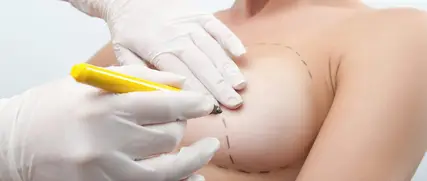
The implant is placed behind the mammary gland, on the pectoral muscle, or sometimes even behind it. Your mammary gland will therefore be in front of the implant, so it can be examined normally, and it will conceal the implant.
I usually make the incision for placing the implant through the areola, generally along its lower edge.
The scar will most often become practically invisible. Sometimes, in the case of a small areola or a particular problem, the incision may be placed in the fold under the breast, an incision that is increasingly used.
The procedure is performed under general anaesthesia, with a hospital stay of 24 to 48 hours.
In the case of liposculpture alone, the harvest consists of liposuction with a fine cannula (see the chapter on liposuction). A compression garment is therefore needed on the donor areas, and anticoagulation is advisable if the harvest is large. In the breasts, the fat is re-injected through very small incisions. The amount re-injected must not be excessive, which is judged by the tension of the skin. Pain in the breasts is slight.
In some cases, it is possible and desirable to combine a small liposculpture with the placement of breast implants, if it is anticipated that the edge of the implant may be visible on a part of the breast where the gland is thin. This liposculpture is less straightforward to perform later, with the implants already in place, since the risk of damaging them afterwards is not nil.
You will have a supportive Elastoplast dressing for a few days, and then you will wear a non-underwired bra with good support. You will have just a compress on the scar, and the running stitch will be removed 6 to 12 days after the operation.
Recovery is not particularly painful; many patients have practically no pain. On the first night, a painkiller may be needed to ease a feeling of tightness. As I have told you, the result once the dressing is removed will be excellent: the shape will be good, the breast soft, and the implant practically impossible to detect.
If liposculpture has been combined with the implants or performed alone, bruising is often significant. It resolves gradually over a few weeks. Recovery at the liposuction donor site is as usual.
The main problem associated with implants that may appear later is a scar reaction around the implant, which sometimes occurs and, if nothing is done, may lead to a round, hard breast.
This problem of “capsular contracture” around the implant is less common with the new implants with an irregular (textured) surface.
You will be shown local care and massage, but in fact the most important thing is to come back and see me quickly if you ever feel a breast hardening during the first few months. It is rare to have to operate again to completely release the capsule surgically. Once again, therefore, the pros and cons must be weighed. If your chest is really flat, the risk seems justified to me; if, on the other hand, you want an augmentation of breasts that are simply a little small, you should think carefully.
As for the risk of cancer, it does not appear to be increased at all, as shown by the follow-up of patients who have now been operated on with silicone for almost 20 years.
Implants are the reference technique for reconstruction after breast cancer. In 2014, certain extremely rare types of lymphoma were found around certain implants.
Find out more about implants and breast cancer (in French) >>
34 Avenue d'Eylau 75016 Paris
Personal assistant Else STOKER
TELEPHONE +33 (0)1 53 57 87 65
WHATSAPP +33 (0)6 83 55 29 04
Monday to Friday

Cosmetic, plastic and reconstructive surgery
© All Rights Reserved.