1 to 2 hours
Outpatient or 1 night
1 year
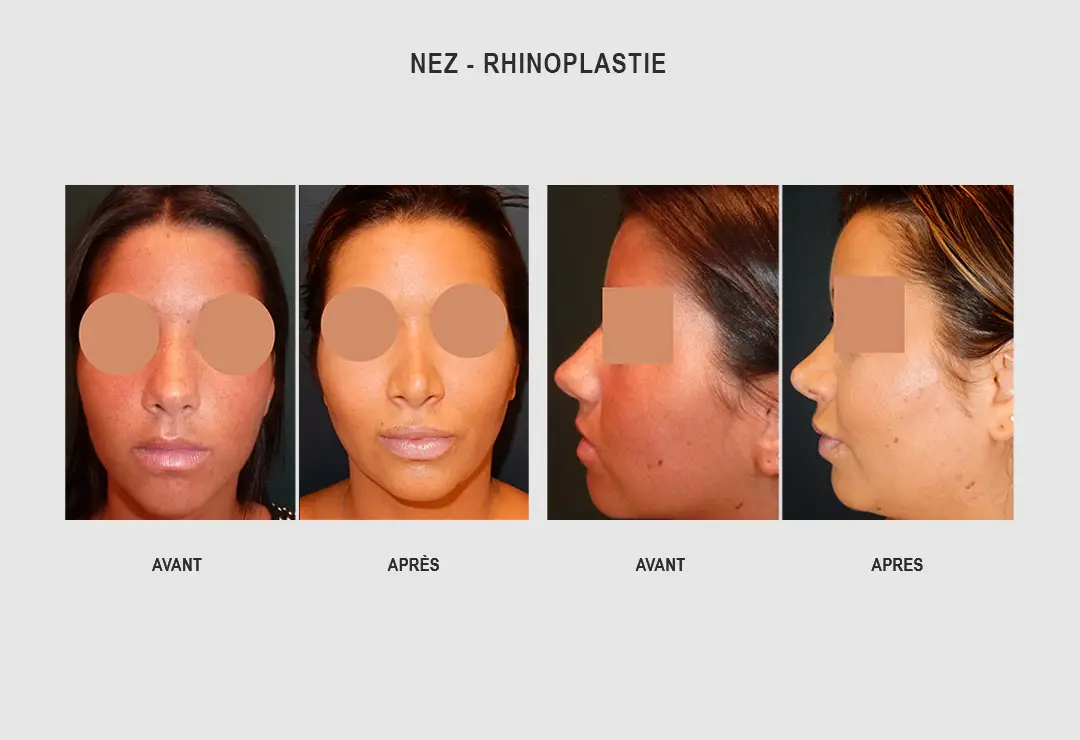
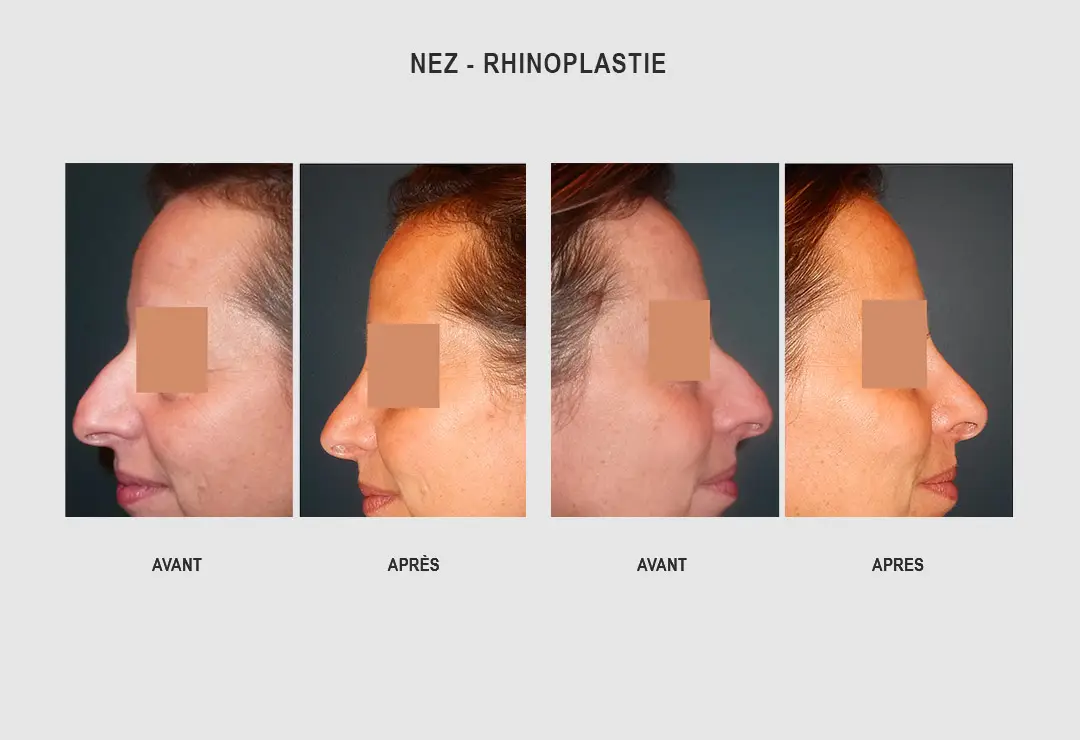
Through invisible internal incisions, the nose can be reshaped at its tip, its base and its bridge, in particular when the bridge has a hump.
The initial breathing discomfort reflects a temporary internal swelling, and the final appearance only becomes truly visible after 6 months or even 1 year. The changes should not be too pronounced, so that the face keeps its original character.
See the SOFCPRE information sheet on rhinoplasty (in French) >>
The nose essentially consists of a bony and cartilaginous framework, covered with skin and lined with mucous membrane. Through incisions hidden inside the nostrils, the skin and mucous membrane can be separated from the osteocartilaginous framework, which can then be reshaped almost at will.
The skin and mucous membrane then settle back into place, and the thinner the skin, the faster it adapts to the new framework. In some cases of long or wide nostrils, they can be reduced at their base, leaving a barely visible scar in the natural fold at the base of the nostril.
After examining the inside of the nose, the nasal septum can be straightened if it is deviated, as this is essential to obtain a straight nose without breathing difficulty. The goal is a harmonious nose that does not look as if it has been operated on. To achieve this, your future nose must suit your face: the aim is not to produce a standard or copied nose, but to keep your own nose while correcting its flaws.
In any case, we will meet again to examine the photographs of your nose together, and I will show you my surgical plan, so that we fully agree on the goal, on how much the hump is to be reduced, and on the shortening and reshaping of the tip.
Anaesthesia may be combined, local with sedation at the time of the injections, or more often general. You will usually be able to go home the same day, but you may spend the night following the operation in the clinic if you prefer.
You will have a cast on your nose, held in place with adhesive strips. The nostrils are sometimes packed with gauze to keep the mucous membrane in the correct position. In that case, the packing is most often removed the following morning. You will clean your nose with dry or moistened cotton buds.
Most patients do not experience pain, but find it difficult to breathe through the nose for a few days, as with a heavy cold. Optimal breathing returns within a few months. The eyes may sometimes be swollen during the first few days, but the swelling subsides very quickly.
The incisions made inside the nose are closed with absorbable sutures. There are therefore no stitches to remove, unless work was needed on the nostrils or the columella. Some oozing often occurs during the first few days. It should be wiped away with a cotton bud or a compress. During this cleaning, a few drops of blood may appear. There is no cause for alarm, except in the exceptional case of heavy and persistent bleeding.
The cast is removed after six to ten days.
Do not rush to the mirror, unless you are one of those patients who show very few marks. Quite often there is some swelling at the root and on the sides of the nose, and bruising of the lower eyelids is common.
All of this settles quickly, and three weeks after the operation there is usually nothing left to see. Even right after the cast is removed, lightly tinted glasses will let you go completely unnoticed, as the nose itself looks almost normal straight away. These glasses must not rest on the bridge of the nose: you will need glasses with side supports, or glasses suspended from the forehead with tape. In any case, you will come back to see me during the first month, so that I can monitor your progress and advise you on local care.
Usually, no trace of the operation should be visible after three weeks. The tip of the nose will remain slightly sensitive and a little stiff, and it will in fact take six months to a year for everything to return to normal; throughout this time the nose will continue to refine, to lose its swelling and to regain its suppleness. You will then come back to see me so that we can assess the final result together.
I advise you to avoid the sun during the first few months, as your nose would swell much more. You can protect yourself with a hat, sunscreen, or even a small paper nose guard.
After two to three months, your nose will be as strong as before, no more and no less. If you receive a blow, a fracture may occur, which will have to be treated like any other nasal fracture, by repositioning the displaced bones.
You will be able to resume all your normal activities after three weeks, including all sports, except scuba diving, which should be avoided for six weeks. Your sense of smell should not be permanently affected by the operation, but it may be reduced initially because of the swelling of the mucous membranes.
Some irregularities may appear as healing progresses, some temporary, others more permanent. As I have explained, a touch-up is sometimes necessary, but in general it is best to wait one year before performing it, in order to obtain the best final result.
When the nose was initially very asymmetrical, a slight residual asymmetry may persist, but as I have explained, the two sides of the face are never perfectly symmetrical in their natural state, and a minimal degree of asymmetry is entirely acceptable.
34 Avenue d'Eylau 75016 Paris
Personal assistant Else STOKER
TELEPHONE +33 (0)1 53 57 87 65
WHATSAPP +33 (0)6 83 55 29 04
Monday to Friday

Cosmetic, plastic and reconstructive surgery
© All Rights Reserved.