2 to 4 hours
1 to 3 days
3 to 6 months
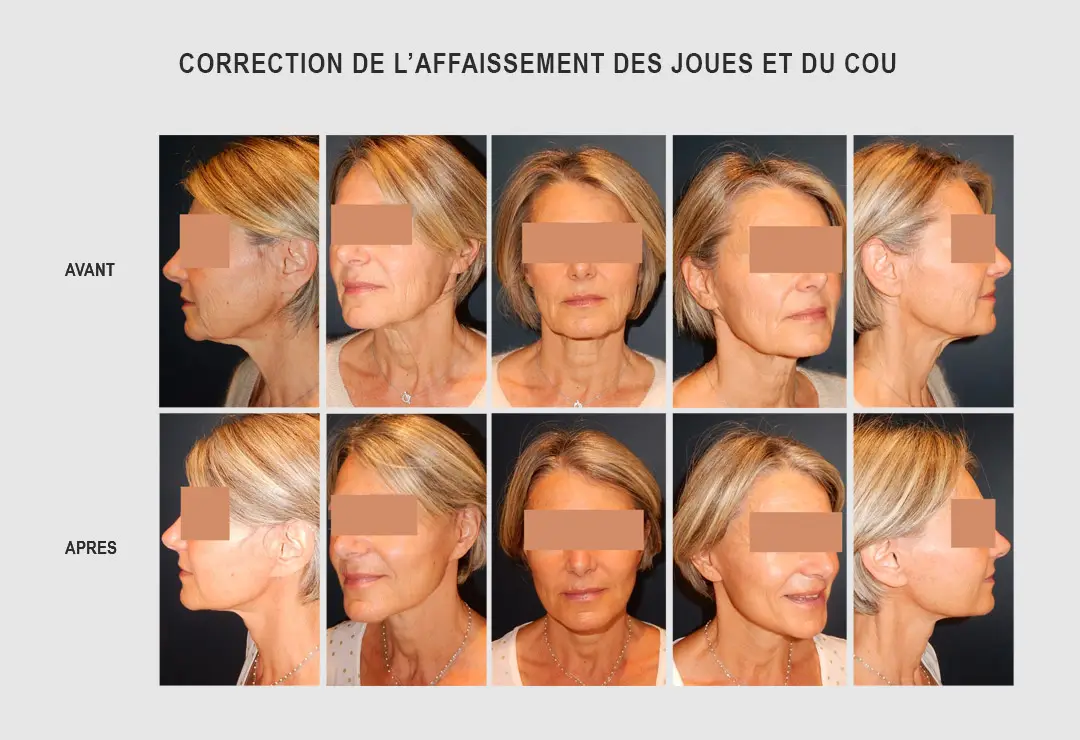
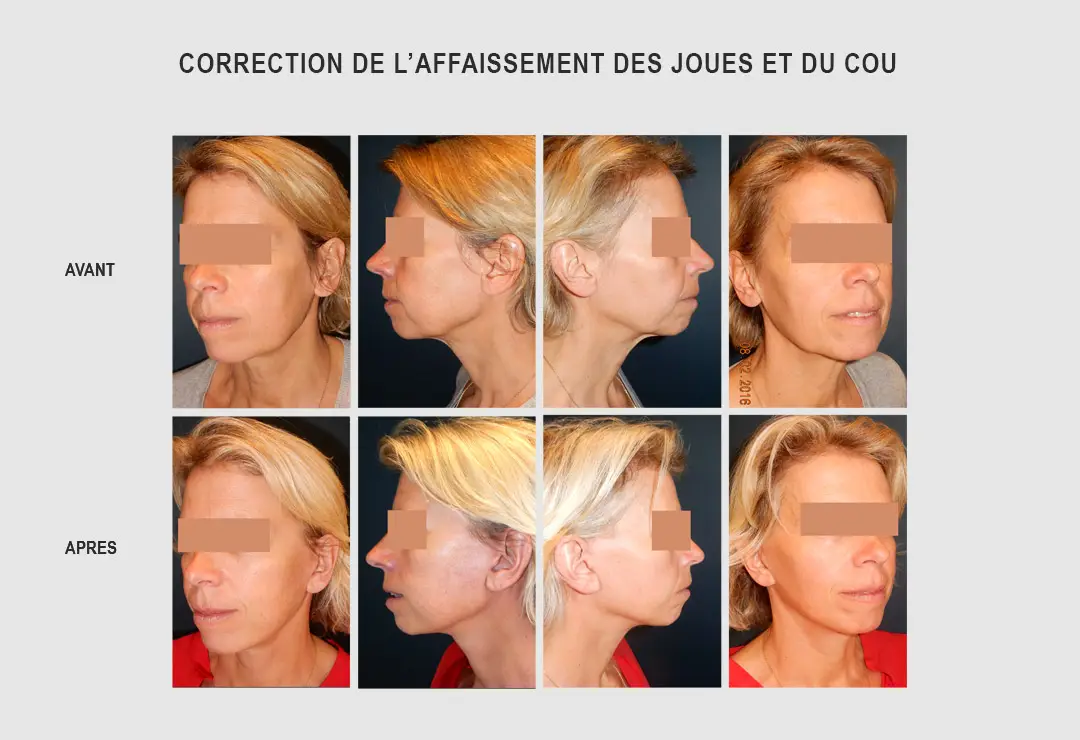
The cervico-facial facelift restores the oval of the face and retightens the skin of the neck when it has become loose. It also corrects the area under the chin (double chin).
These changes are subtle yet effective, and do not alter the expression of the face. The facelift must be adapted to each person and gives a healthy, rested look. Thanks to their well-chosen placement, the scars are minimal.
See the SOFCPRE information sheet on the cervico-facial facelift (in French) >>
At what age should one have a facelift? There is no set age, because facial ageing varies greatly from one person to another, depending on the bone structure of the face, the nature of the skin, weight variations, sun exposure and heredity.
It may be desirable to have a facelift when the beginnings of a jowl appear, when a step forms below the mouth in line with the natural fold between the cheek and the upper lip.
At that point, it is preferable to intervene to restore tension to the cheek, because otherwise a wrinkle forms and becomes established from the corner of the mouth, which is particularly ageing, and a late facelift will only be able to reduce it. In the neck, on the other hand, it is always possible to retighten loose skin.
It is necessary to assess the state of your skin, the amount of subcutaneous fat, and the tone and distribution of the muscles of the face and neck. Sometimes only the cheeks need to be tightened, without touching the neck; exceptionally, the reverse. If you smoke, you absolutely must tell me, because tobacco has a negative effect on the blood supply to the skin, and it is crucial to stop at least one month before the procedure. Nicotine substitutes can help, with less toxicity for the tissues.
The scars are usually placed in the hair at the temple, run along the rim of the ear, where they are very well hidden, go around the earlobe, pass behind the ear and back into the hair. Very quickly, the only possibly visible part of the scar will be behind the upper part of the ear, between the ear and the hair, fairly high up and about 1.5 cm long. You will therefore be able to wear your hair short or in a bun once the scars have faded, after six months to a year. If your neck is heavy, an additional incision of a few millimetres under the chin may be necessary to remove the fat at this level. It will leave only a small scar, very well hidden in a natural fold.
For this procedure, you will have combined anaesthesia: during a brief period of sleep, I will give the local anaesthetic injections (see practical information).
I will remove the excess skin and sometimes a little fat from the neck and lower cheeks. I will sometimes use suction to remove excess fat. In most cases, I will also have retightened the muscles and fascia.
Even though the tendency to bleed is moderate during the procedure, as a precaution I will most often use a drain on each side. The drain is then removed 24 or 48 hours after the procedure. In most cases, it helps to limit post-operative bruising.
I will then suture carefully. The stitches will be placed mainly in the hair, and only a few millimetres of hair will be shaved on either side. I will have advised you to wash your hair the day before the operation, before coming to the clinic, but your hair will be washed again at the end of the operation, before you are put back in your bed. A dressing is not systematic, but is sometimes necessary to keep the skin under moderate compression, particularly if drains are used.
You will be lying on a clean cloth.
It is then very important to keep your head and neck in a good position. You should avoid lowering your chin or bending your neck, and instead keep your chin up as if you wanted to lengthen your neck. A large pillow should therefore be avoided in favour of support under the shoulders and the nape of the neck. Ideally, keep your head straight. If you want to turn your head, turn your shoulders instead, and make all movements gently. In general, it is essential to remain as calm as possible during the first post-operative days, especially the first 48 hours.
The incident to be feared is a haematoma. It is encouraged by a rise in blood pressure, agitation, rapid movements and exertion.
Pain is usually minimal and short-lived; you will feel more of a sensation of tightness. But even if you feel very well, stay calm if you want to avoid a haematoma and keep your recovery simple. You will of course be able to get up the day after the operation, and you will leave the clinic the day after that.
On the second or third day, you will in any case be able to wash your hair, which will need it. If you are lucky enough to have little swelling and no bruising, you can be perfectly presentable after about ten days.
As I have told you, it is nevertheless wise to allow two to three weeks without commitments, as it often takes this long for the swelling and bruising to subside and for you to be able to have your hair coloured or bleached by a hairdresser who is used to these situations.
After three or four weeks, it is usually no longer visible that you have had an operation.
For yourself, however, you will have to wait at least six months to a year for the scars to have completely flattened and faded, and for you to feel, when touching your cheeks, the same suppleness as before the operation. It will also take this length of time for skin sensation to return completely. In the cheeks and neck, where the skin has been lifted in order to be retightened after removal of the excess, there will indeed be a temporary reduction in sensation.
The result is obviously not permanent, but it usually takes 8 to 10 years for the skin to loosen enough to return to the state you were in at the time of the first operation. A new facelift can be performed without any particular difficulty, a rotation at the temple allowing me to avoid raising the hairline too much.
A facelift that is not performed too late, far from damaging the skin, actually improves it by keeping it under tension and preventing deep wrinkles from forming. Studies of skin sections have even recently shown that a facelift has a rejuvenating effect on the skin itself.
34 Avenue d'Eylau 75016 Paris
Personal assistant Else STOKER
TELEPHONE +33 (0)1 53 57 87 65
WHATSAPP +33 (0)6 83 55 29 04
Monday to Friday

Cosmetic, plastic and reconstructive surgery
© All Rights Reserved.