Home / Cosmetic surgery of the body / Liposuction of the thighs, hips and abdomen
45 min to 1 hour 30
Outpatient or 1 night
3 months
Liposuction is the most frequently performed procedure in the world. For liposuction to give its best results, the fat deposits must be localised, the skin elastic, the quantities removed reasonable, and the patient’s general health good.
It is a reshaping of the contours, and in no way an alternative to weight loss. If, on the contrary, liposuction were performed on someone who is severely overweight, on areas that are too diffuse, with inelastic skin, and especially in the presence of an underlying health problem, then the result would be disappointing at best and the procedure potentially dangerous.
See the SOFCPRE information sheet on liposuction (in French) >>
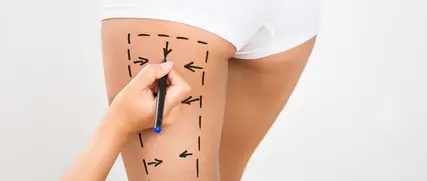
Excess roundness at the hips is more commonly known as “saddlebags”. The location of the excess fat must be assessed. It may be mainly on the side, but there may also be excess below the buttock fold, and there may be a further build-up higher up. The quality and elasticity of the skin and the presence of “cellulite” (dimpling) will have to be assessed in order to choose the best technique. It is almost always a matter of removing fat, as the indications for surgical excision are exceptional.
Through very short incisions, fine cannulas are introduced, allowing the fat to be removed using powerful suction or a syringe.
The removal is performed closer to or further from the skin depending on the case. Excess fat can thus be removed as required. A compressive Elastoplast dressing or a compression garment is applied for one to three weeks. The risk of phlebitis is limited by getting up early and often by a prescription for anticoagulants to thin the blood for a few days. Bruising is more or less significant. This simple method, which leaves no scars, requires great precision to avoid asymmetry and irregularities. Touch-ups are sometimes necessary.
Elastic skin is, of course, more favourable.
You will always have to wait 2 to 3 months to be able to judge the result.
As after any liposuction, pain is well controlled by moderate-strength painkillers. You will wake up wearing the compression garment (this garment, which you will have brought before the operation, must have been tried on beforehand and must not be too tight). In the hours following the operation, there is almost always some harmless blood-tinged oozing through the garment. For this reason, especially if the procedure was performed late in the day, it is preferable to stay at the clinic overnight and leave the next day. Showering is possible from the next day, and to limit pain, you can shower while keeping the garment on, which allows it to be washed painlessly as it avoids pulling on the operated areas.
After 3 or 4 days, when the pain has decreased, you will be able to remove the garment for your shower. Swelling and bruising can be impressive, especially as the almost systematic prescription of anticoagulants tends to increase them, but they will have disappeared after a month. However, skin retraction is slower and will take a further 2 months to develop, which means that the final result will only be seen after 3 months.
34 Avenue d'Eylau 75016 Paris
Personal assistant Else STOKER
TELEPHONE +33 (0)1 53 57 87 65
WHATSAPP +33 (0)6 83 55 29 04
Monday to Friday

Cosmetic, plastic and reconstructive surgery
© All Rights Reserved.