They share common characteristics:
- Anaesthesia is combined, with a short period of sleep at the start during which the local anaesthetic injections are given.
- The hospital stay is short, 24 to 48 hours.
- The scars must be barely visible.
Anaesthesia
It is usually carried out as follows:
Already drowsy from the premedication given in your room, you will be taken to the operating theatre where everything is prepared for the operation: the face is disinfected with soapy water, the surgical drapes are placed and the incisions are drawn.
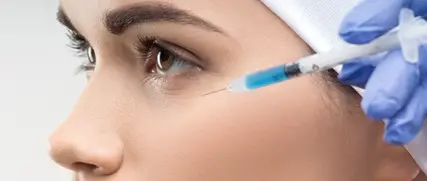
When everything is ready, the anaesthetist, who has placed a drip in a vein, will inject a product that will put you completely to sleep for a few minutes. During this time, I will carry out the local anaesthesia.
With the area to be operated on completely numb, a mild sedative will make you drowsy, and the procedure will proceed comfortably.
It is, however, perfectly possible to put you completely to sleep, and even to use general anaesthesia. This decision will be made according to your age (under 20, it is the rule), your nervousness and the extent of the operation.
You will discuss this with the anaesthetist, whom you will meet before the operation and who will decide with you.
The hospital stay is short
For certain limited operations, you will be able to go home at the end of the afternoon.
Otherwise, the next morning I will come to check on you and explain the post-operative care, and you will be able to leave during the morning.
Only in the case of a facelift will I ask you to stay one more day.
Recovery and scars
The face, which is very rich in blood vessels, reacts strongly to injury, and a surgical procedure, even when performed gently, is an injury.
This reaction shows itself in two ways: bruising and swelling.
- Bruising reflects the spread of a little blood under the skin, the ordinary “bruise” after a knock. As it is gradually reabsorbed, the skin turns from blue to green to yellow. The extent of the bruising is difficult to predict. It will certainly disappear, more or less quickly, usually within 3 weeks.
- Swelling, or oedema, is the other way in which the tissues of the face react. This swelling can be very rapid and sometimes impressive around the eyelids and cheeks. It usually subsides very quickly, with most of it gone within a few days.
A little patience is needed (10 days to a month) for these phenomena to disappear.
After that, no one will be able to tell that you have had an operation.
Scars on the face must be practically invisible, hidden at the periphery, in the hair, the ears or the nostrils.
They are only exposed on the eyelids, but this is the one place on the body where a scar usually becomes almost invisible.