45 min to 1 hour 30
Outpatient
3 months
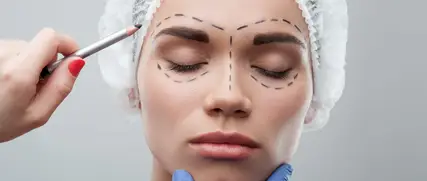
Eyelid surgery, or blepharoplasty, refreshes a tired-looking gaze without changing its expression, by removing excess skin from the upper eyelids, reducing bags under the eyes, or both at the same time.
The internal scars are invisible, and the external ones are almost invisible.
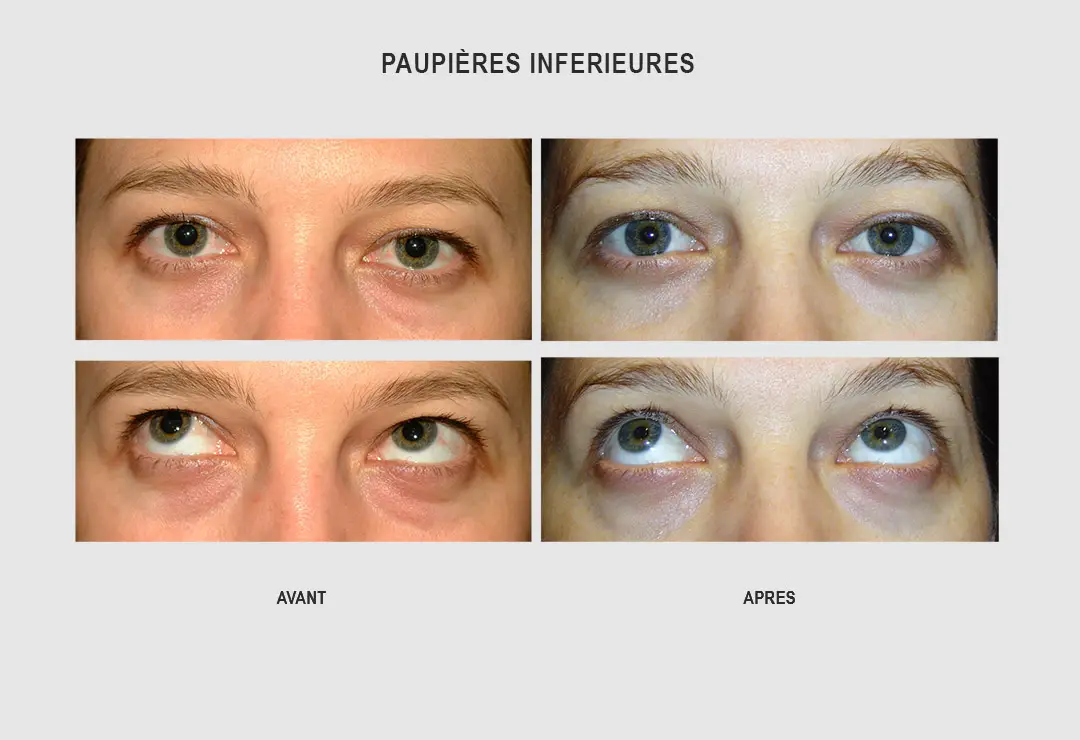
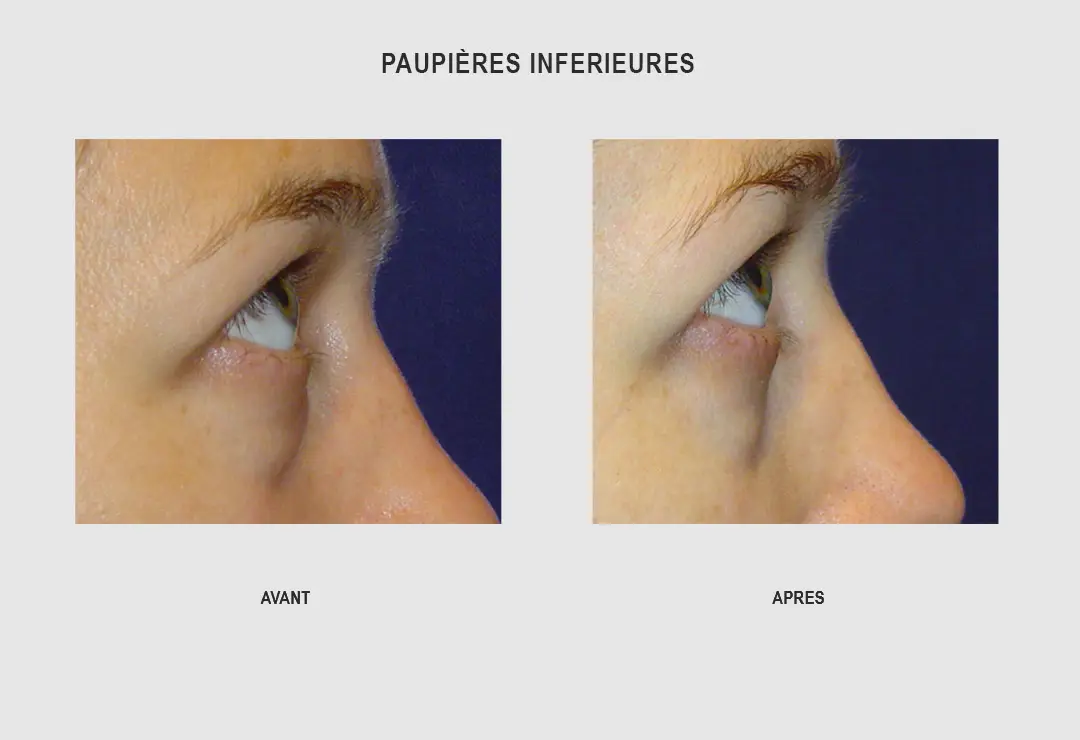
It is possible to remove excess skin from the upper eyelids, and/or remove the bags from puffy lower eyelids, or both.
This painless procedure can be combined with most other facial procedures, in particular a facelift.
See the SOFCPRE information sheet on cosmetic eyelid surgery (in French) >>
You have expressed the wish to remove excess skin on the eyelids, or bags, often both.
The “bags” seen on the lower eyelids, but also often near the nose on the upper eyelid, are in fact fatty hernias. This is the fat normally located around the eye, which bulges forward when the membrane holding it back stretches.
In some people this membrane is abnormally weak and the “bags” appear very early in life. This special, very fine fat is very sensitive to variations in the body’s water content, and can therefore deflate and swell very quickly. However, once it is there, only surgery can get rid of it.
Anaesthesia is either combined, local anaesthesia with a brief period of sleep at the time of the injections (see practical information), or general. Most often, eyelid surgery is performed as an outpatient procedure.
You will keep your eyes closed and cooled as much as possible, to minimise post-operative swelling. If only the upper eyelids are operated on, strictly local anaesthesia may be sufficient. For lower eyelid surgery, a brief general anaesthesia is more comfortable.
Many patients have an excellent night; some complain of a slightly painful feeling of tightness, easily relieved with a painkiller. In the event of significant pain, tell the nurse if you are at the clinic. The next morning, swelling and bruising can be reduced with a prescription for local care (cold compresses and ointment). Ice cubes in direct contact with the skin are prohibited.
The ideal is to apply cold compresses (water chilled in the refrigerator), changing them regularly during the first 24 hours. The eyelids swell very quickly, and you may be worried, but the swelling goes down very fast. Watery eyes may also make reading uncomfortable for a few days. You will come back 3 or 4 days after the operation to have the stitches removed, remembering to apply plenty of ointment beforehand, which makes removal easier and painless. You will then stop the ointment but may continue for a few days with the drops I have recommended. Eyelid surgery obviously rules out driving for several days.
One week after the operation, it is quite possible that you will have hardly any visible marks left.
You may also still have some bruising, particularly on the lower eyelid, which will disappear in about three weeks.
You will of course be able to wear make-up. You should avoid exposing yourself to the sun with your eyes closed for about two months. With your eyes open, and even better with sunglasses, there is no risk. It will take about four months for the scars to soften and fade, and for the result to be final. You will come back to see me then, as I want to see the final state.
This operation should give you a stable result for many years. A further operation is always possible without any problem, but it must be carried out with particular care.
Previously, there was no satisfactory way to remove fine lines and the crinkled appearance of the eyelids. Chemical peels are very delicate to handle on the eyelids, and the skin is too thin for dermabrasion.
The very controlled removal of the superficial layer of skin with a defocused laser, on the other hand, allows eyelid wrinkles to be treated.
The advantages are the disappearance of fine lines or a very marked reduction of more established wrinkles, while maintaining a normal appearance in terms of texture and colour. The disadvantages are the length of the recovery: 8 to 10 days before healing and 3 to 6 weeks, sometimes more, for the colour to return to normal; the redness may persist for several months, but it can easily be covered with make-up.
Laser treatment can be used in several ways on the lower eyelids when the excess skin is limited. The fatty hernias, the “bags”, can be removed from the inside, through the conjunctiva, with the laser used only on the skin. On the other hand, when the excess skin is significant, it is preferable to perform the classic operation, tightening the skin, and to use the laser as a complement a few months later.
Some faces have pronounced hollows under the lower eyelids, either alone or combined with bags above them. In these cases, a small re-injection of your own fat can be offered to fill these depressions. The rule is therefore rather under-correction, which can be corrected, than over-correction, which is difficult to fix. Lipofilling is painless, but may leave bruising for longer. Lipofilling can improve dark circles (excessively dark colouring of the lower eyelids).
34 Avenue d'Eylau 75016 Paris
Personal assistant Else STOKER
TELEPHONE +33 (0)1 53 57 87 65
WHATSAPP +33 (0)6 83 55 29 04
Monday to Friday

Cosmetic, plastic and reconstructive surgery
© All Rights Reserved.